The Garden's Service Spine: Plan the Boring Bits and the Pretty Bits Will Thank You
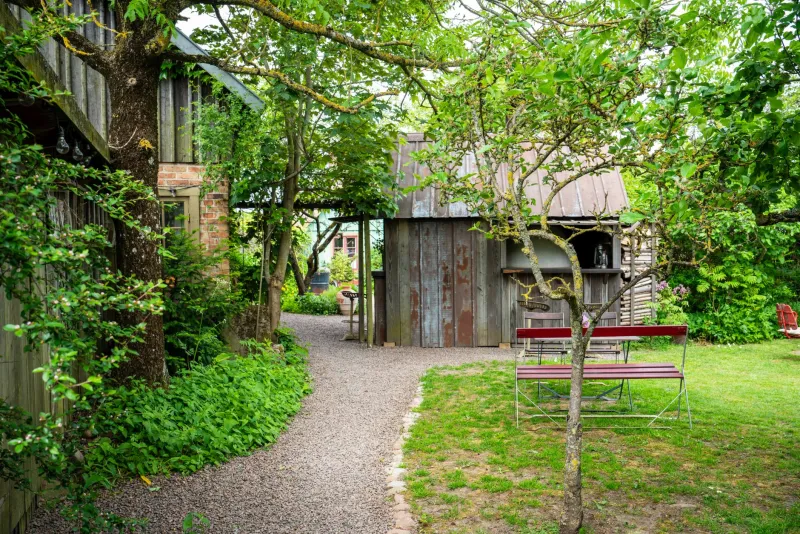
Most garden designs begin with the good stuff. A border here, a bit of porcelain paving there, maybe a pergola with something scented climbing over it. All lovely. But before any of that lands, a garden has to do a job. It has to take a wheelie bin on collection day, a barrow full of compost, a hosepipe that needs to reach the far border, and a shed door that opens without scraping the fence.
That unglamorous backbone is what I call the service spine. Get it right and the pretty parts feel effortless. Get it wrong and every small task becomes a shuffle, a scrape or a soggy shortcut across the lawn.
Start with the route, not the shed
Before deciding where the shed goes, watch how the garden is actually used. On bin day, what is the shortest sensible route from the back door to the gate? When the compost needs emptying, where does the barrow need to go? When it has been raining for three days, which path do you naturally take to the tap?
The answer is usually a route, not a single point. Make that route hard-surfaced and generous enough for a barrow or a trolley. Stepping stones look charming, but they are miserable with a loaded wheelbarrow. A narrow gravel path can work, but only if the edging is robust and the gravel is contained; loose shingle on a slope is a ankle-turning menace.
Keep corners wide. A tight ninety-degree turn is fine on a drawing and annoying in real life. If the route crosses a lawn, accept that it will wear, or reinforce it with a mowing strip or a discreet paved track. In a business garden, think about deliveries, maintenance trolleys and staff moving bins or boxes. The route needs to work for the people who use it every day, not just for the person who mows once a fortnight.
Give bins a proper bay, not a corner of shame
Wheelie bins, recycling boxes and food caddies need more space than most people allow. You need room to pull a bin out, open the lid, clean it and put it back without wrestling it past a plant pot. A paved or easily washed surface is sensible, with a slight fall away from the house. A dark, airless nook will smell; a slatted screen or a ventilated store is better than a solid box with no airflow.
In a small UK garden, the side return is often the obvious home. In a front garden, keep kerbside access simple: no one wants to drag a bin through a gate that only opens halfway. Screening should hide the bins from the house or the street, but it should not block access. A slatted fence, a trellis with an evergreen climber, or a purpose-made bin store with lift-up lids can all work. Just check that the store is big enough for the bins you actually have, not the ones you wish you had.
Compost close to the kitchen, but not on the patio
Compost works best when it is easy to use. If the bin is at the far end of the garden, the kitchen caddy will sit on the worktop until someone gives up and puts it in the general waste. Put the compost area on a level, firm surface with room to turn or empty it. A bay or a bin with a lid is fine; a heap that is open to the weather and the local wildlife is less fine.
Screen it if it offends the view, but do not bury it behind a hedge that makes access a job in itself. Leave space for a barrow and a fork. If you have a water butt, put it near the shed or greenhouse where the downpipe is, and make sure the overflow has somewhere sensible to go.
Sheds need breathing room
A shed is only useful if you can get things in and out of it. That means a base that is level and clear of standing water, a door that swings freely, and a path that does not turn into a mud slide in November. Avoid tucking a shed into the dampest, most shaded corner simply because nothing else will grow there. Tools and timber prefer dry conditions.
Think about security too. A shed that is hidden from the house may be convenient for the view, but less convenient for keeping an eye on. A lock, a visible position and a bit of lighting can make a difference. If you need power, plan it before the base goes down; trailing extension leads across wet grass is not a good look, and it is not safe either.
Taps, power and the small things that matter
An outdoor tap is one of the cheapest upgrades with the biggest effect. Put it where it can reach the beds without dragging a hose through the kitchen, and consider a frost-free tap if you are replacing one anyway. A water butt near the shed or greenhouse is useful, but only if the overflow is directed away from foundations and paving.
For power, use a qualified electrician and proper outdoor-rated fittings. Weatherproof sockets and a residual current device are not optional extras. Think about where you will actually use power: mower, strimmer, lighting, perhaps a heated propagator. A socket in the shed is handy; a socket halfway down the garden is only handy if you planned for it.
Drying lines are another working element that often gets overlooked. A rotary drier needs sun and breeze, not the shadiest corner under a tree. A retractable line can be pulled out when needed and tucked away afterwards. Either way, give it a clear route and enough space to walk around the washing without trampling the border.
Screen the works, don't suffocate them
Screening is the bridge between the working garden and the pretty garden. Use slatted timber, evergreen hedging, trellis or a store with a green roof. Keep a gap for air and access. Avoid thorny planting right beside a route used with a barrow. The aim is to soften the view, not to build a maze.
In a small plot, stack functions where you can: a bin store that doubles as a bench, a shed with a green roof, a narrow path that also takes the hose. But do not overcomplicate it. A simple, well-built working zone is better than a clever one that nobody can use.
Business gardens need a back-of-house too
For a business, the service spine matters just as much as the welcome. Staff need somewhere to put bins, store tools, park a maintenance trolley or access a tap. Clients do not need to see it. Separate the service route from the entrance route, screen the bins, and make sure deliveries and maintenance can happen without crossing the middle of a seating area.
A few metres of paving, a decent gate and a well-placed tap can save hours over a year. It also makes the garden safer, because people are not stepping over hoses or squeezing past bins.
The order of work
Start by listing the jobs the garden has to support: bins, compost, tools, water, power, drying, deliveries, maintenance. Then map the routes between them. Mark the wet, muddy or awkward spots. Decide where the working core will sit, preferably on a side return, along a boundary or at the back of the plot, rather than in the sunniest sitting spot. Lay the hard surface, sort the drainage, put in the utilities and build the storage. Screen it. Then, and only then, start choosing the wisteria.
The pretty bits are better when the boring bits work. A garden that can take a barrow, a bin and a hosepipe without a fight is a garden that will actually get used. And that is worth planning for before the first plant goes in.