The Off-Season Framework: Designing a UK Garden That Reads Well From November to March

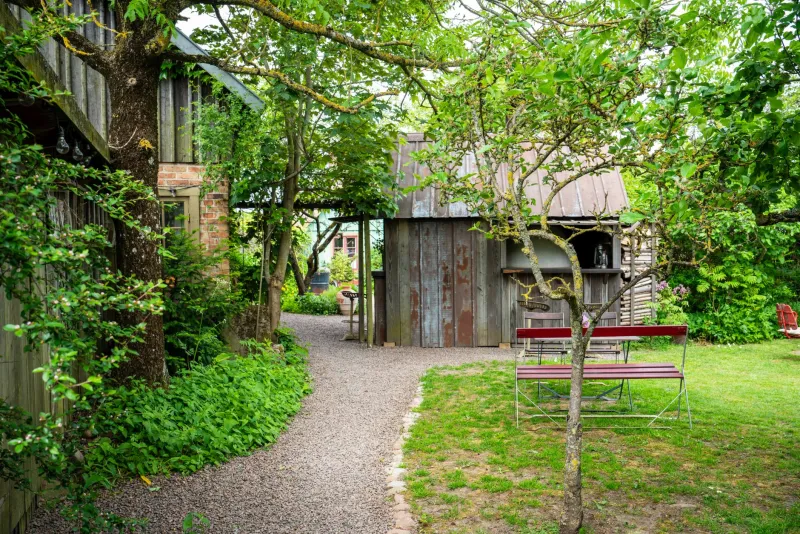
Photo: Horep, CC BY-SA 4.0, via Wikimedia Commons
Most UK gardens are designed for June. That is understandable: June is when the borders do the heavy lifting, the lawn is at its best and every plant is keen to show off. But a garden is viewed all year, and from November to March it is viewed mostly through a window, in flat light, with a cup of tea in hand. That is the honest test of whether the layout works.
A winter garden does not need to be a show garden. It needs a readable skeleton: a few strong shapes, a clear route through the space, some texture that catches low light, and enough contrast to stop the whole plot turning into a brown smear. Get that right and the summer planting has something to sit on. Get it wrong and even a generous planting budget can feel like it disappears for five months.
Start with the view from the house
Before moving a single plant, spend ten minutes doing what you actually do in winter: stand at the kitchen window, the back door, the living room glass. Look at the garden as a picture, not as a series of jobs. What holds your eye? What looks like a collection of sticks? Where does the eye slide straight past everything and hit the fence?
This is also the moment to notice the bits you have been ignoring since September. The empty pot by the patio. The bit of border that is only ever seen from the shed. The corner where the bin store has become the main event. Winter exposes structure, and that includes the structure you did not plan.
Make a rough sketch. Not a designer's plan, just a few circles for shrubs, a line for the path and arrows for the views that matter. Mark the spots that look bare from indoors. Those are your candidates for winter interest, not the far corner you never see.
Evergreens: fewer, better, placed with intent
The temptation is to buy a row of evergreens and call it structure. A row of identical conifers is structure in the same way a filing cabinet is furniture: useful, but not exactly welcoming. What you want is a handful of distinct shapes that do different jobs.
A rounded evergreen, such as a clipped box or a compact holly, gives a solid anchor. A vertical shape, perhaps a Portuguese laurel or a yew trained as a loose column, lifts the eye. A low mound, maybe a dwarf pine or a hebe in a sheltered spot, keeps the ground from looking empty. Three or four well-placed evergreens will do more than twenty dotted about.
Placement matters more than quantity. Put the strongest evergreen where you will see it from the house in January, not where it is convenient to plant. If it has to earn its keep in a narrow border, choose something that can be clipped and kept in check rather than something that will sulk and swallow the path.
Grasses and stems for movement and light
Deciduous grasses are the quiet heroes of the off-season. They hold their shape after the seed heads fade, and they move in the slightest breeze, which makes a still winter garden feel alive. In a UK garden, a clump of Miscanthus or a shorter Deschampsia can carry a border through to late winter, provided it is not flattened by snow and is cut back at the right time in spring.
Stems are just as useful. Cornus in red, orange or acid green is almost too easy, but it works. Willow is another reliable option, especially in damper spots. The trick is to plant them where the low winter sun can get behind them, so the stems glow rather than sit in shadow. A single group of three dogwoods at the back of a border will do more for a grey afternoon than a whole tray of pansies.
Bark, berries and the case for a little colour
Bark is the most underrated winter feature in British gardens. A birch with white stems, a snakebark maple, or a mature acer with patterned bark can carry a view on its own. Berries are the other obvious win, but they need to be positioned where you will actually see them. A pyracantha against a wall is good; a pyracantha hidden behind a shed is bird food.
Do not overdo the colour. A garden that is trying to be loud in December often looks tired by February. One or two deliberate accents are enough: a cluster of red stems, a white-stemmed birch, a berry-laden holly. The rest can be green, brown and grey, which is what winter does best anyway.
Hardscape is part of the skeleton
It is easy to think of hardscaping as a summer job. In winter, it becomes the garden's backbone. A path that is clear and navigable, a patio that does not turn into a sheet of green algae, a retaining edge that looks intentional rather than improvised: these things matter when the planting has stepped back.
Check the practical bits now, while the garden is quiet. Is the path wide enough to use in wet weather? Does water sit in a low spot by the door? Are the steps safe when frosty? If you are adding hardscape, choose materials that look good wet. Stone, clay pavers and gravel tend to improve with age and damp; some pale concretes do not. A simple edging detail can make a border look considered even when there is nothing much in it.
Let the summer planting wait its turn
A winter skeleton should not compete with the summer show. That means avoiding too many large evergreens in the middle of a border that will be packed with perennials in July. Put the structural plants at the edges, at the back, or in dedicated pots. Leave the centre free for the plants that will do the seasonal work.
This is also a good time to move things. A shrub that has outgrown its spot is easier to shift in damp autumn soil than in a dry June. A grass that flopped over the path can be divided and repositioned. A pot that looked fine in summer can be swapped for something with more presence in winter. The garden is not a fixed drawing; it is a working arrangement.
A short autumn audit
If you do only a few things this month, make them these: look from the house and note the dead spots; choose three evergreens with distinct shapes and place them where they will be seen; leave grass and stem plants standing rather than cutting everything down; check paths, steps and drainage; and move one thing that has been annoying you since summer. That is enough to change how the garden reads from November to March.
Winter is not the garden's off switch. It is the season when the design has nowhere to hide. A little structure now will make the whole plot feel more intentional, and it will give next summer's planting a far better frame.