Water Where It Falls: Retrofitting Rain Gardens Into Everyday UK Hardstanding

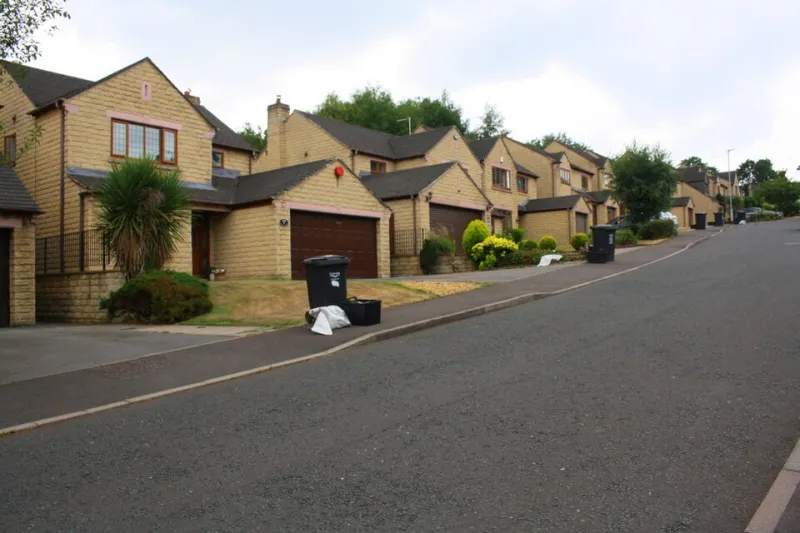
Photo: Basher Eyre, CC BY-SA 2.0, via Wikimedia Commons
A rain garden is not a pond, a bog or a badge of eco-virtue. It is a shallow, planted depression that takes rainwater off hard surfaces and lets it soak away slowly. That is it. And that simplicity is exactly why it works beside ordinary UK driveways, patios and car parks — not just on grand self-build plots with a sustainability consultant on speed dial.
Most UK gardens and commercial grounds already have the raw ingredients: a downpipe, a slope, a patch of lawn that goes squelchy every January. The trick is to route the water somewhere deliberate, size the storage sensibly and plant it so it looks like a design decision rather than a drainage accident.
Start with the water, not the plants
Before you buy a single grass or dig a single spade, watch where water goes during heavy rain. Does it sheet across the patio? Pool against the garage? Run down the drive and out to the road? A rain garden works best when it intercepts runoff before it reaches a drain, a neighbour's boundary or a low corner of the garden.
The basic shape is a shallow bowl or a gently graded swale. For most domestic plots, 150–250mm of storage depth is plenty. Keep the base level so water spreads out rather than scouring a channel, and make sure the edges are level too. A rain garden that is 300mm deep in one corner and 100mm in another is just a hole with ambitions.
Sizing rules of thumb that actually help
Work out the area of hardstanding that will drain to the rain garden — the connected area. As a starting point, aim for 5–10% of that area as planted storage. On clay soils, compacted subsoil or a shady site, push towards 10–15%. A 40m² patio might need 2–4m² of rain garden. A 50m² driveway might need 3–5m². For a commercial car park, treat every 8–10 bays as a small catchment and use a 10–20m² planted strip or a series of smaller cells.
Depth matters less than drain-down time. A rain garden should empty within 24–48 hours after heavy rain. If it still has standing water after two days, the subsoil is probably too compacted or the sizing is too tight. Break up the base, fork in organic matter and consider a sand/gravel layer or a perforated underdrain leading to a soakaway — subject to local ground conditions and approval.
Routing runoff without creating a problem
Water needs an easy, controlled path. A kerb cut, a shallow channel, a gravel-filled trench or a level spreader can all guide runoff into the planting. Keep the inlet calm: a messy waterfall of water will erode soil and look awful. A cobble apron or a small forebay gives silt somewhere to settle and makes maintenance much easier.
Keep storage away from building foundations, especially on clay. As a practical minimum, aim for 3–5m clearance from walls where ground conditions are poor, and check with building control or your local authority if you are altering levels close to a structure. Never route foul drainage or contaminated wash water into a rain garden. For car parks, fit a silt trap or forebay before the planting, and consider oil separation if the catchment is busy.
On a driveway, a fall of about 1:100 towards the garden is usually enough. A shallow swale along a boundary can carry water with check dams or small berms to slow it down. The aim is not to move water quickly; it is to move it without drama.
Planting for UK rain and dry spells
Rain gardens are binge-drinkers: wet in winter, dry in summer. Choose plants that tolerate both, and stick mostly to robust UK-friendly species. At the wetter base, consider Carex elata 'Aurea', Iris pseudacorus, marsh marigold and purple loosestrife — but keep vigorous spreaders contained. On the shoulders, use Deschampsia cespitosa, Molinia caerulea, ferns, Astrantia and Persicaria amplexicaulis. For structure, Cornus alba and smaller birches work if space allows.
Avoid invasive species and anything that sulks in winter wet. Plant in autumn or early spring, water through the first summer and mulch with gravel or Pebble at inlets. Repeat planting in bands or blocks — it reads as intentional and makes maintenance easier.
Making it look deliberate
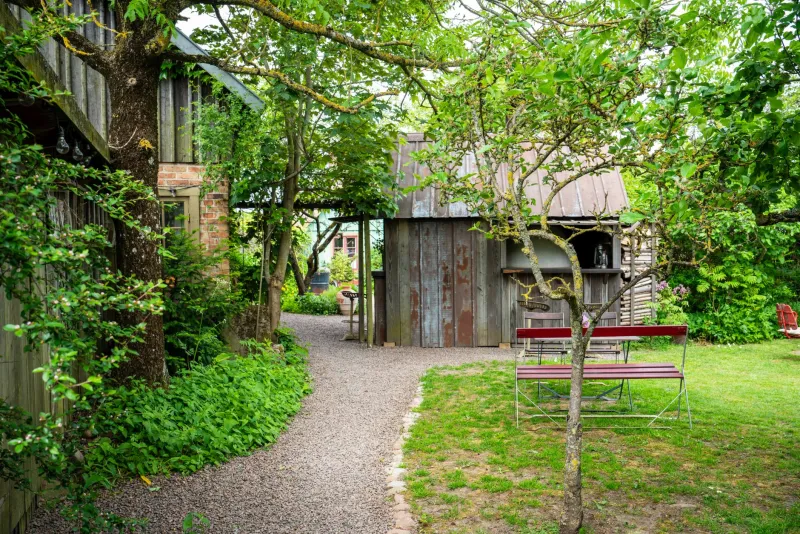
A rain garden fails aesthetically when it looks like a muddy dip. Fix that with crisp edges, a clear inlet detail and a tidy margin. Steel edging set flush with the lawn, a gravel apron, a mown strip or a repeated curve all help. A rectangular basin beside a patio looks architectural. A linear swale along a drive looks like a designed drainage channel. A circular bowl in a lawn looks like a feature.
Keep the planting dense enough to cover the soil but not so dense that you cannot see the inlet. In small gardens, one well-detailed rain garden is better than three apologetic puddles.
Planning and practical permissions
Most domestic rain gardens are permitted development, but check before you dig if you are in a conservation area, near a listed building, on a slope that affects neighbours, or close to a public highway. Commercial schemes may need SuDS approval, planning conditions or building regulations sign-off under Part H. Do not connect to a public sewer without permission.
Maintenance that keeps it working
Twice a year, clear leaves and silt from the inlet and forebay. Cut back perennials in late winter, but leave seedheads over winter where they are not causing a blockage. Check drain-down after heavy rain. Replant bare patches. On commercial sites, keep a simple log — insurers and facilities teams like evidence that drainage is being maintained.
A rain garden is not maintenance-free. It is, however, a lot less expensive than repairing flood damage, replacing a ruined patio or explaining to a client why the car park floods every time it rains.